
Two long films are being shown simultaneously in French cinemas this summer: La Bataille de Gaulle (L’âge de fer et J’écris ton nom), directed by Antonin Baudry. It relate the life of General De Gaulle during World War II in London, Africa and back to France after D Day. They are being viewed by a public of all ages, including parents who want to show their children who the great man was. One Parisian film critic has called these two films De Gaulle for dummies, and cartoon movies but not serious history films. Aïe, as we say in French.
Let’s start with De Gaulle for dummies : in fact, the film is based on “A certain idea of France, the life of Charles De Gaulle”, a 2018 book written by the British historian Julian Jackson, who was also an adviser to the films’ director. His book covers the whole life of De Gaulle, born in 1890 to a teacher in a catholic school, “highly educated, thoughtful, full of culture and tradition, the man who had the biggest influence on me”, as he described him. After leaving the military academy of Saint Cyr in 1912, Charles De Gaulle went to the front of the first World war and was injured in two attacks while most of his soldiers and his fellow officers died. When he left the hospital for the second time he went straight to Verdun under the commandment of Marshall Pétain (who condemned De Gaulle to death in 1940 for desertion and who was himself sentenced to death by a tribunal in 1946, commuted by De Gaulle to life in prison). With most of the men in his regiment killed De Gaulle was thought to be dead and received a military citation for bravery from Pétain. In fact he was a war prisoner in Germany, where he tried to escape five times before being freed in 1918. From the end of WWI until the beginning of WWII, he held a few positions in the ministry of defence and was posted to Germany, Poland and Lebanon. At the start of the war, as a colonel, he commanded a regiment of tanks. In May 1940, his two offensives against German panzers were among the very few French military successes. He was promoted to the rank of brigadier-general, effective June 1st, 1940 and appointed Under-Secretary of State for national defence and war on June 5th just before the total military defeat of France.
Any other man would have then retired to his gentilhommière in Colombey les Deux Eglises to write his Mémoires. Not him. On June 17th, he disembarked in Plymouth, rushed to London and 10 Downing Street, where Prime Minister Winston Churchill gave him a slot at the BBC to send a message to the French. On June 18th, after Pétain, as new head of the French government, had declared an armistice with Germany and asked the French to stop fighting, De Gaulle told the French that they had to continue the fight and that he, and only he, represented France. For the next four years he battled relentlessly, first alone in a hotel room in London, then with a growing number of followers, until he became head of the French government in exile, de facto head of the French Résistance and commander in chief of an army of Free French soldiers and officers. They landed in Normandy and liberated Paris and Strasbourg before joining the final fight in Germany. From 1944 until 1946, De Gaulle headed the provisory government in Paris to make sure that France was recognized as one of the winning countries in the war and recovered its international position. He left after he failed to initiate a change of regime and impose his view on the future of France. From January 1946 to June 1958, he stayed in his country home and wrote his Mémoires de Guerre, for some, a masterpiece or literature and one of the best books ever written about the second world war, for others, an egotistical, self-serving, confusing and way too long pensum. For The Wall Street Journal (November 22nd, 2024 when the Mémoires were reprinted in English), it is admirable and infuriating in equal measure. Admirable, because the great set-piece scenes were fine works of literature. Infuriating, because his narrative offered such a partial, anti-British and anti-American version of the events of WWII as to be useless as objective history . Ouch…
In 1958, in the middle of a war of independence in Algeria and with the risk of civil war in France, De Gaulle came back to power as the last Président du Conseil of the IV Republic. Julian Jackson compares the first six months after his return to Paris to the first six months of Napoleon Bonaparte as a First Consul for having the same determination and the same energy (the fact that De Gaulle was 68 when Napoleon was only 30 years old makes it even more amazing). He then became the first President of the Fifth Republic after having a new constitution approved by referendum. He led the country for eleven years, accelerating decolonization and following a policy of Grandeur and Indépendance politically as well as economically (civil and military nuclear power, aeronautical and space industries, naval shipyards, computing and banking services, etc.). He was elected twice as a President, and left power for good when losing a referendum in 1969. While he could have suffered a violent death so many times (at the front of two world wars, at the hand of assassins, by frequently flying in fragile airplanes during the war), he died peacefully of a stroke in 1970 while playing card in his country home, aged 79.
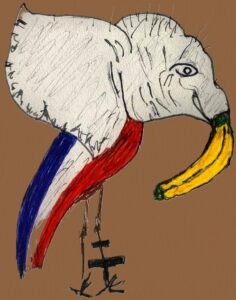
Now for the categorization as “cartoon movies” of the films La bataille de Gaulle. According to Julian Jackson, Charles De Gaulle himself has said that he did not have an “attractive appearance”. When he walked down the Champs Elysées during the liberation of Paris, the Parisians, who knew only his voice on the BBC, discovered him en chair et en os. A journalist described him as larger than life, seemingly made of wood, half Pinocchio, half Sicilian puppet, rigid as a pole, intimidated and intimidating . When he arrived in London in 1940, somebody asked Alexander Cadogan, Permanent Secretary of Foreign affairs in Churchill’s cabinet, how was De Gaulle. He replied, I can’t tell you anything about him, other than he has the head of a banana and the hips of a woman. After meeting him that same year Daniel Cordier, a new recruit in the French free forces in London who was to become the private secretary of Jean Moulin, coordinator of the French Resistance, described De Gaulle as having too long and fragile legs which did not seem to be able to support his massive body; I thought that he looked like a heron. The French journalist Robert Mengin, who had lunch with De Gaulle, said that the General had medieval features and the eye of an elephant. How cartoonish, indeed, but it seems to me that De Gaulle could better be compared to a rabbit. Not any rabbit, though, but Bugs Bunny, the one who gets flattened, blown-up, dropped of a cliff, then pops back two seconds later, grimacing, whistling and asking casually: “Hey, what’up?”.
De Gaulle was beloved by his followers, sometimes mystically, and hated by his opponents, sometimes fanatically. He survived more then thirty assassination attempts during his political life. One of his would be assassins, before being shot, said that it was even more justified to kill Charles De Gaulle than to kill Adolf Hitler, because the Führer at least did not bring dishonour to the German army, as De Gaulle did to the French one (in Algeria). Jonathan Swift wrote in « Thoughts on various subjects, moral and diverting » : when a true genius appears in the world, you may know him by this sign, that the dunces are all in confederacy against him. This sentence is quoted by John Kennedy Toole in his book “A confederacy of dunces”. R.I.P., Charles de Gaulle.